
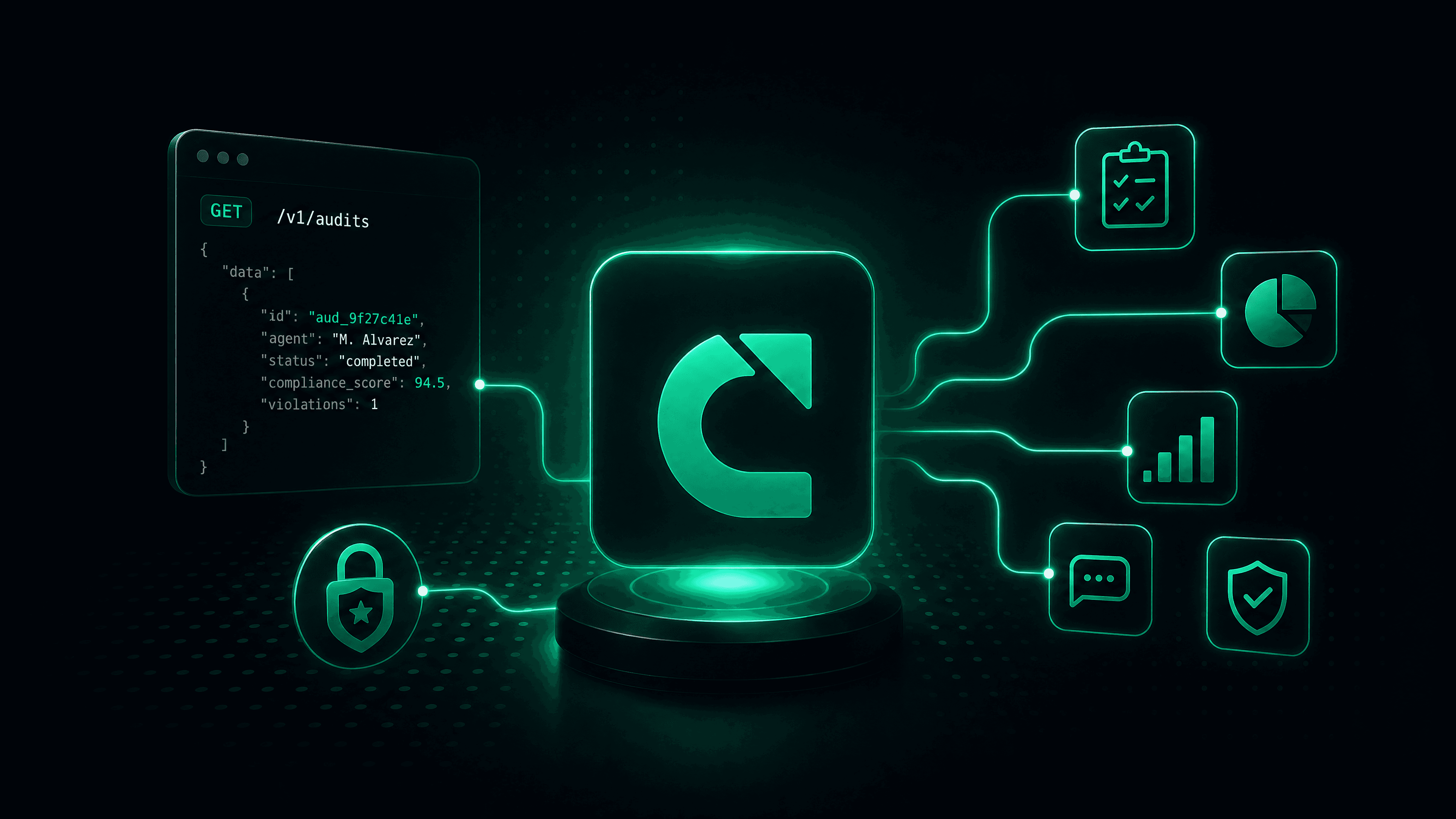
The Calladhere Public API v1 is live. Your audits, violations, transcripts, and compliance analytics, served over clean REST endpoints and ready for your data warehouse, your BI tool, and the internal apps your team builds. Create a key and start pulling.
Your compliance data already answers hard questions, as long as you ask them inside Calladhere. But your stack doesn't live inside Calladhere. It lives in the warehouse where every other system lands, in the BI dashboards your leadership reads every Monday, in the internal tools your ops team quietly builds to hold it all together. Until now, getting compliance data into that world meant exports, downloads, and copy-paste. The data was yours; the plumbing wasn't.
That changes today.
What you can pull
The API covers the data you actually reach for, in plain English:
- Audits. List them with filters, then pull the full detail on any one: scores, violations, question-by-question results, and recommendations. You can also go a level deeper into question-level results, including the AI's confidence and second-pass verdicts.
- Call transcripts. The full conversation from any audited call. Transcripts are PHI-gated, and we cover exactly what that means below.
- Compliance summary. Aggregate stats and score trends for any date range, ready to drop straight into a dashboard.
- Violations. Individual violations with severity, repeat flags, and score impact, plus aggregate summaries when you want the shape instead of the rows.
- Agent performance. Per-agent audit counts and average compliance scores.
- Organization info. Who the key is connected as and exactly what it can access, so your integration can check itself.
Audits
Compliance
Violations
Agents
Organization
Scoped keys, created in a minute
Keys live under Settings, API Keys, and each one is scoped to exactly what it should see: a broad read scope for the warehouse job that pulls everything, or granular per-resource scopes for the dashboard that only needs violation counts.
The secret is shown once at creation and stored only as a hash on our side, so treat it like the credential it is. Rotation is built in: rotate a key and the old one keeps working through a grace window you choose, so your deploys never race a credential swap. And every key is pinned to your organization; credentials from anywhere else are rejected outright.
Create API key
Name
warehouse-sync
Scopes
Secret shown once at creation
Create keyYour first call in thirty seconds
Drop the key into an Authorization: Bearer header (X-API-Key works too), GET /v1/audits, and you get back clean JSON with cursor pagination that walks your whole history. That's the whole onboarding.
$ curl https://api.calladhere.com/v1/audits?limit=25 \
-H "Authorization: Bearer sk_live_••••••••••••"
The same guardrails, because it's the same data
This is insurance data, so we'll be blunt about the rules.
- API Terms first. You sign the API terms right in the app before the first key can be created.
- Transcripts are treated as PHI. The transcript endpoint requires its own explicit scope AND a signed, countersigned Business Associate Agreement. A broad read scope never inherits transcript access. No executed BAA, no transcripts. Period.
- Every disclosure is logged. Each request that returns records is written to an access log built for HIPAA accounting of disclosures, so "who saw what, and when" always has an answer.
- Read-only, on purpose. Every endpoint is a GET. Nothing your integration does can modify an audit, a checklist, or a customer record.
- Rate limits that match your plan. Per-key, per-minute limits scale with your plan tier, and responses tell you exactly when to retry.
Built-in guardrails
API Terms signed in-app
Accepted before the first key is created.
Transcripts require an executed BAA
Exact scope, never inherited.
Every disclosure logged
For HIPAA accounting of disclosures.
Read-only by design
Every endpoint is a GET.
Per-key rate limits
Matched to your plan.
The docs live where you work
Full documentation and a per-endpoint reference ship inside the app under Help: every endpoint with its parameters, response fields, and copy-paste examples. Your developers can go from "we should integrate this" to a working request without ever leaving Calladhere.
One platform, two front doors
If yesterday's MCP server announcement sounded familiar, that's because the MCP server rides on this same API. Same keys, same scopes, same guardrails. MCP is the front door for AI assistants; REST is the front door for everything you build yourself.
v1 is the start, not the finish
The foundation is solid and the guardrails are done, but the shape of what comes next is up to the people building against it. That's you. If you hit an endpoint that's missing, a filter that isn't there, or a field you need and can't find, tell us. Every piece of feedback goes straight into the roadmap, and right now, at v1, it carries the most weight.
The bottom line
Your compliance data belongs in your stack, not trapped behind an export button. Point your warehouse at it, build the dashboard your leadership keeps asking for, wire up the internal tool your ops team has been sketching. The API is ready when you are.
The v1 API is available to every Calladhere agency today. Sign the API terms (and a BAA for transcript access) right in the app under Settings, create a key, and make your first call.
Questions, or want a hand with your first integration? Reach out to your account manager or email us at hello@calladhere.com. And keep the feedback coming: it's how v1 becomes the API you actually want.